
The brain is an organized biological system built from multiple interacting levels. Molecules influence cellular behavior, cells communicate through specialized connections, neural circuits process information, and larger brain systems coordinate complex functions.
A single neuron can receive signals from many other cells, linking individual cellular activity to broader networks of communication. Understanding the brain therefore requires connecting information across several biological scales.
Molecular Biology → Cell Biology → Neurobiology → Neural Circuits → Brain Systems
Molecular Organization
At the molecular level, researchers investigate the genes, RNA, proteins and signaling pathways that contribute to neural cell identity and function.
Gene expression is not identical across all neural cells. Different populations can have distinct molecular profiles that influence their development, connectivity and physiological properties.
Large-scale single-cell studies have demonstrated this molecular diversity by identifying distinct cell populations across the nervous system and organizing them into molecular taxonomies.
read more here
Molecular Architecture of the Mouse Nervous System — Cell, available through PMC
Cellular Diversity
Molecular differences are reflected in cellular diversity.
The nervous system contains neurons as well as several populations of glial and other supporting cells. These cells differ in morphology, molecular characteristics, location and function.
Single-cell transcriptomics has made it possible to examine this diversity at much greater resolution, revealing cell populations that may appear similar using traditional approaches but have distinct molecular signatures.

the picture above shows a typical single-cell workflow, dissociated cells are first individualized in droplets or (micro)wells using microfluidics or other devices. Subsequently, the polyadenylated RNAs from each cell are captured using special oligodT primers that contain barcodes that allow to distinguish the polyadenylated RNAs that come from individual cells as well as mark the unique RNA molecules captured within each cell.
Individual neural cells do not operate independently. Neurons communicate through electrical and chemical signals, allowing information to move between connected cells.
The properties of individual neurons and the connections between them jointly influence how neural circuits operate. This creates a transition from cellular properties to coordinated network activity.
Circuit Architecture
Connections between neurons create organized neural circuits.
Researchers study these connections to understand how groups of neurons process information. Circuit architecture includes the arrangement of neurons, the types of connections between them and the patterns through which information can flow.
Different brain regions contain different circuit architectures, providing structural foundations for specialized neural computations.
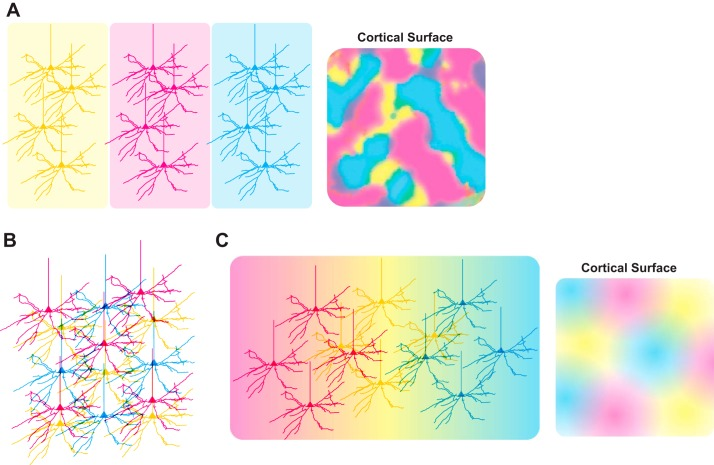
the picture below shows Structural and functional tiling at the circuit level in the cortex. A: the visual system of carnivores and primates is organized into segregated functional columns by receptive field property (left). Tiling and superposition of these columns (right), as opposed to dendritic arbors or individual neurons, allows each property to be represented at each retinotopic location in the cortex. B and C: the structural/functional organization of rodent visual cortex is not conclusively described. Evidence exists to suggest that subclasses of neurons sharing a receptive field property (magenta, yellow, and cyan cells) may tile the cortex at the individual cell level (B), similar to retinal tiling (Fig. 2B). Other evidence suggests loose spatial clustering of like-tuned cells (C) in a similar but less orderly organization than is found in carnivores and primates. read more
Brain-Wide Organization
Neural circuits are embedded within larger anatomical and functional systems.
Brain organization is therefore not simply a matter of individual connections. Researchers also investigate how circuits are positioned within brain regions, how different regions communicate and how cellular and circuit properties contribute to larger-scale organization.
This creates several interconnected levels:
Molecules → Cells → Neural Networks → Brain Regions → Brain Systems
Connecting Structure, Identity and Function
Modern neuroscience increasingly combines complementary approaches rather than studying each biological level separately.
Microscopy can reveal cellular structure and spatial organization.
Cellular markers can identify specific proteins and cell populations.
Electrophysiology can measure electrical activity.
Molecular analysis can characterize genes, RNA and proteins.
Single-cell technologies can reveal molecular differences between individual neural cells.
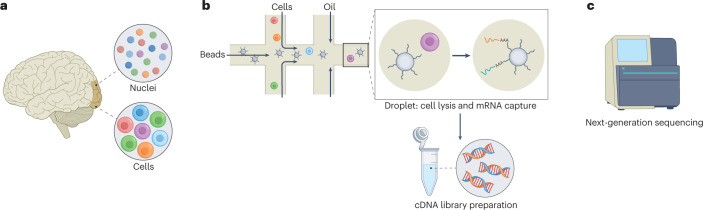
the picture shows Experimental pipeline of a droplet-based single-cell RNA sequencing in a nutshell. read more in the source below
Together, these approaches provide complementary views of the nervous system.
Research using single-cell and spatial transcriptomics, for example, has helped build increasingly detailed maps of cellular diversity while retaining information about molecular states and spatial organization.
Single-cell and spatial transcriptomics: deciphering brain complexity in health and disease
A Multiscale View of Neuroscience
The organization of the brain can be understood as a series of connected biological levels:
Molecular Biology
↓
Cell Biology
↓
Neurobiology
↓
Neural Circuits
↓
Brain Systems
Each level adds information that cannot be fully explained by the level below it alone.
Studying genes and proteins helps explain cellular identity. Studying cells reveals how neural components are organized. Studying circuits shows how neurons interact, while brain-wide research connects these interactions to larger functional systems.
This multiscale perspective allows neuroscience to move from individual molecular components toward a more integrated understanding of nervous system organization.
Explore the Research Pathway
Discover the experimental approaches used to investigate neural cells, their molecular identity, electrical activity and organization.